EB0010 Standard Detector Base
Detector base accommodates IRIS and ENEA series detectors, equipped with short-circuit plate which ensures continuity in the event of removal of the detector from the line.

Showing 25–36 of 160 results
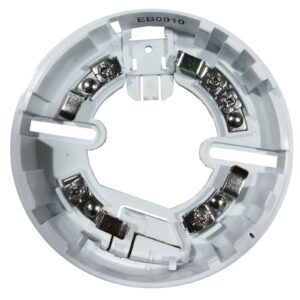
Detector base accommodates IRIS and ENEA series detectors, equipped with short-circuit plate which ensures continuity in the event of removal of the detector from the line.
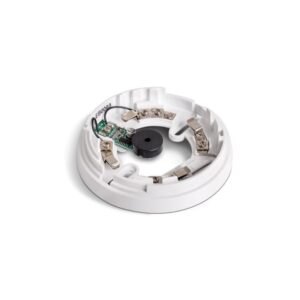
The EB0060 base features an integrated buzzer controlled by the sensor’s “R” output. This function enables local alarm signaling, enhancing system safety and usability.
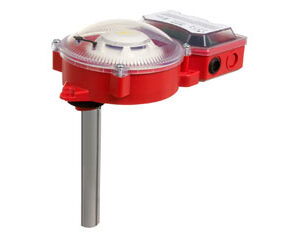
Smoke detection in ventilation ducts prevents smoke and toxic gases from spreading between compartments, reducing risks for occupants. These devices enable the use of point detectors without installing them directly inside the duct, where high air velocity would otherwise impair their performance.
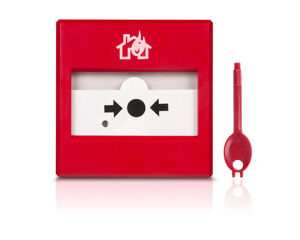
The EC0020 alarm button is a manual device that can be reset using a plastic key (included), designed to ensure clear and immediate activation thanks to its colored band and indicator LED
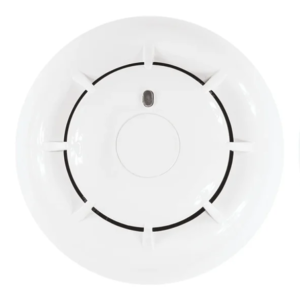
The ED100 smoke detector from the Enea series uses the Tyndall effect (light scattering) to providehighly accurate detection of particles generated by a fire. Its ability to respond promptly makes it ideal for environments where early detection is crucial. The optimized design of the detection chamber, the superior seal, and the 500-micron insect screen ensure excellent protection against false alarms. Furthermore, the detector’s sensitivity can be easily adjusted to different operating conditions, thanks to four selectable levels (0.08, 0.10, 0.12, 0.15 dB/m).
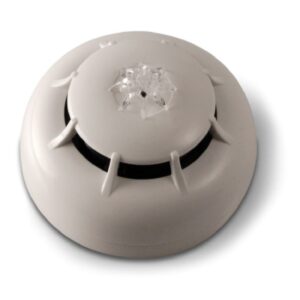
The Enea ED200 series detector is designed to ensure accurate temperature detection, even in conditions where smoke can cause false alarms. It can be configured in various operating modes (A1R, B, A2S, BR) with fixed thresholds between 58°C and 72°C and thermal velocity measurement capabilities. This versatility makes it particularly well-suited for industrial environments, professional kitchens, or mechanical rooms, where optical detection may be ineffective. The ED200 is a reliable solution for thermal monitoring of sensitive areas.
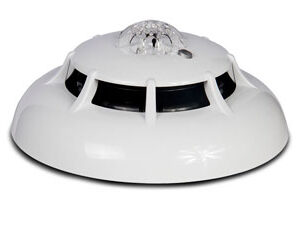
The Enea ED300 model combines optical smoke detection with thermal detection, offering high performance in any type of fire scenario. Thanks to five operating modes selectable from the control panel (PLUS, OR, AND, SMOKE ONLY, TEMPERATURE ONLY), the device adapts perfectly to a variety of safety needs. PLUS mode ensures maximum sensitivity for critical fires, while AND mode offers maximum false alarm rejection. The ED300 is the ideal choice for environments where high standards of reliability and operational flexibility are required.
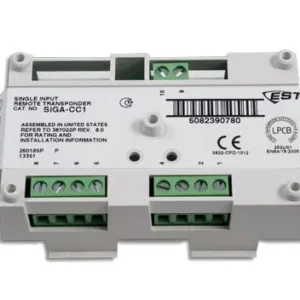
The Edwards EST SIGA-CC1 is an intelligent addressable signal module designed for use with Edwards Signature Series fire alarm systems. It allows the fire alarm control panel to connect and control supervised Class B signal circuits used for notification appliances, audio evacuation speakers, or firefighter telephone circuits.
The module operates under command of the Signature loop controller and can switch power inputs to controlled circuits depending on its programmed personality code. It supports multiple applications including audible/visual notification power selection, audio evacuation, and telephone circuits with ring-tone generation.
The SIGA-CC1 features built-in intelligence and microprocessor-based operation, enabling faster system response and improved reliability. Signature Series devices automatically report their location on the loop using automatic device mapping, simplifying system commissioning and maintenance. Electronic addressing is performed directly by the loop controller without manual switches or dials.
.btn {/* Darker background on mouse-over */
.btn:hover {
background-color: RoyalBlue;
}
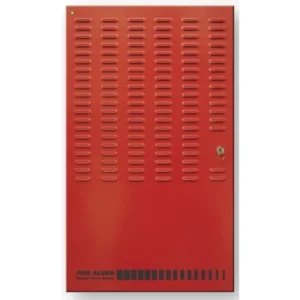
The Auxiliary Power Supply (APS) is a UL 864, 9th Edition listed power supply. It is a 24 Vdc filtered-regulated, and supervised unit that can easily be configured to provide additional notification appliance circuits (NACs) or auxiliary power for Mass Notification / Emergency Communication (MNEC), as well as life safety, security, and access control applications.
The APS contains the circuitry to monitor and charge internal or external batteries. Its steel enclosure has room for up to two 24 ampere-hour batteries. For access control-only applications, the APS can support batteries totaling up to 65 ampere-hours in an external enclosure. The APS has four Class B (convertible to two Class A) NACs. These can be activated in one or two groups from the APS’s unique dual input circuits. The APS has a door-mounted AC power indicator LED.
The APS also has room for and can power a number of different modules. These can be Signature AA-30 or AA-50 dual-channel audio amplifiers, SIGA-UIO modules and/or SIGA-RELs. A MN-BKRT3 can also be installed. This bracket can accommodate an MN-NETSW1 Ethernet network switch, an MN-FVPN VoIP module and a MN-COM1S Communications module.
The APS is available in 6.5 or 10 ampere models. Each output circuit is has a capacity of three amperes; total current draw cannot exceed the unit’s rating.
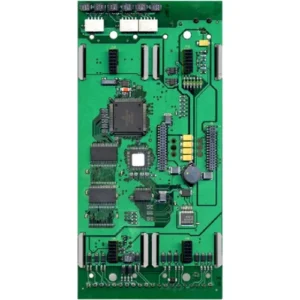
The 3-CPU3 is the Central Processing Unit Module monitoring the status of all modules and providing the link for network communications. Although each local rail card contains their own microprocessor, the 3-CPU3 provides all inter-module communication and has the ability to download rail module operating parameters. Upon power up the 3-CPU3 automatically learns all local rail module attributes and locations. Site specific software is loaded into the 3-CPU3 which then downloads data to each local rail module. Firmware upgrades are also done from the 3-CPU3 eliminating the need to unplug chips on rail modules.
Mounting must be in the first two local rail spaces of the upper 3-CHAS7 (module chassis). Options for the 3-CPU3 include the addition of an LCD display and User Interface, RS-232 Communication Card, and RS-485 Series Network Communication Cards.
The 3-CPU3 is fully compatible on the same network with the 3-CPU and 3-CPU1 modules.
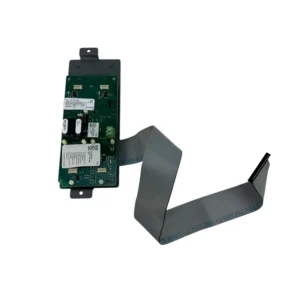
EST3 networks easily configure to single or multi mode fiber optic or combination fiber optic / copper networks using the 3-FIBMB2 Fiber Optic Communications Interface and the appropriate fiber optic transceivers. The 3-FIBMB2 electronics card plugs right into the CPU. A ribbon cable connects the 3-CPU directly to the 3-FIBMB2 fiber interface card. The interface card mounts in the 1⁄2 footprint space in a 3-CHAS7 chassis or 3-CAB5 enclosure. The 3-FIBMB2 supports from one to four single or multi mode transceivers that plug into the interface card. Each transceiver provides the transmission and reception capability for the network data or digital audio data to/from a 3-FIBMB2 located in the next network node using single and/or multi mode fiber optic cables. The 3-FIBMB2 also supports copper wire connections, permitting network data and audio communications format changes from copper to single mode fiber, copper to multi-mode fiber, and single to multi-mode fiber, as job conditions require. All copper and fiber circuits can be configured as supervised Class B, Class A, or Class X circuits. The 3-FIBMB2 has a constant output test signal that simplifies installing and testing multi-mode fiber circuits only, reducing setup and troubleshooting time. Secondary power input terminals and an external 24 Vdc source can be used to provide continuous network and audio data to flow through the 3-FIBMB2, when the panel is powered down for servicing.
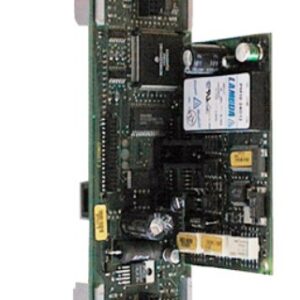
The Edwards EST 3-SDC1 Signature Device Card is a critical component in advanced fire alarm and notification system architectures, designed specifically for professional installation and integration with Edwards Signature Series control panels. This intelligent device card enables enhanced device communication and expanded functionality within complex addressable fire detection networks, providing critical interface capabilities for commercial and institutional building safety systems.
Engineered for precision performance in high-reliability environments, the 3-SDC1 facilitates advanced communication protocols between fire alarm devices and central monitoring panels. Its robust design supports seamless upgrades from standard device configurations, allowing technicians to expand system capabilities without comprehensive panel replacements.